Long before we were serious about having children, the Mister and I spent time listing "great" names for our non-existent children (all twelve of them). By "great" I mean names that made us giggle, whether or not we would actually inflict them on a human child. We've had a series of alcohol names (Ouzo, Galiano, Schnapps and little baby Johnny Red Label), of mixed ethnic names (Jesus Goldstein, Valentino O'Dell, Katerina Suarez, Taguchi Morningstar, Bubba Li, Fitzwilliam Kim) and Old Testament names (Gad and Zilpeh currently, although Joash and several other kings have been considered). Of course, we have the actual names we call our fetus: Mervivian Phogg and Alloicious* (or Alowicious or Allouicious**) and it really is fortunate that Mr. Splashy Pants arrived when she did, otherwise the Mister would call the growing alien monkey that. We have names of creatures, names from literature, horrible adjectives and nouns, names of places, but, I realized yesterday, we don't have any bean names for our baby.
Once in my life I had a friend who was serious about having eight children and serious about naming them after ericaceous plants (plants in the heath/rhododendron family). I had a great time picking out names for her: Heath, Heather, Eric, Erica, Laurel, Kalmia, Pieris, Azalea, and Huckleberry, among others. If Fabaceae (the legumes) is one of the largest plant families (and it is) and one of my favorites, surely I can think of great bean names for my child.
I'm at a total loss, however. None of the common names strikes me as suitable: Mimosa and Indigo might be the closest. I'm more likely to use "little locoweed" than "sweet pea" as a term of endearment. Among the scientific names Glycine max sounds like an interesting character, but not a child. Robinia? Astragalus? Medicago? Psoralea? Pediomelum? Baptisia? Lens? Phaeseolus? Oxytropis? Trifolium? I think not. Any suggestions?
*Mervivian when we feel girlish, Alloicious when we feel boyish. No, we do not know the gender or our child and are not planning on finding out. The only reason I particularly want to know is because "it" is so dehumanizing in English. Still I find the question, "When will you find out what it is?" somewhat offensive, as if the only thing this child has going for it is a penis or lack thereof. Usually I answer that we're pretty sure it is a human, although we certainly haven't ruled out alien monkey based on ultrasound. I find the "What do you want?" question to be very distasteful, and I'm shocked at the women who will answer it in front of their fetus. I don't think it takes having had a miscarriage to realize that any child is miraculous, whether or not childbirth happened 10 billion times or so in the last century. "Mervivian Alloicious, we want you to be a happy healthy person (or alien monkey)."
**Hector Alloicious is a family name (my parents' pet turtle) so Mom and Dad should be able to shed some light onto the proper spelling.
Thursday, March 12, 2009

Sunday, March 1, 2009
Bean Books 1 and 2: Wonderous Wisteria
My first "bean book" was one I happened to have on hand, Barbara Kingsolver's The Bean Trees. I first read The Bean Trees in college and while I did not love it the way I had loved Kingsolver's Animal Dreams, I loved it enough. Kingsolver illustrated for me that one could be a biologist and a novelist, that one could write books with interesting plots and characters that one cares about and that social issues can have a place in fiction. I clearly wanted to be her (sans the insomnia, messy divorce and rural Kentucky childhood). Sometime later I fell out of my infatuation. I enjoyed both Poisonwood Bible and Prodigal Summer, but unlike one friend who thought th ey represented Kingsolver's transition into literature, I thought they were substantially less fun than her earlier works, and a good bit longer. The time I spent defending Animal, Vegetable, Miracle and the locavore movement (both to family members who did and did not read the book) exhausted me with the side effect of making me annoyed with Barbara. All told, it had been many years since I had last read The Bean Trees when I picked it up a few weeks ago, and I was expecting a disappointment.


 ey represented Kingsolver's transition into literature, I thought they were substantially less fun than her earlier works, and a good bit longer. The time I spent defending Animal, Vegetable, Miracle and the locavore movement (both to family members who did and did not read the book) exhausted me with the side effect of making me annoyed with Barbara. All told, it had been many years since I had last read The Bean Trees when I picked it up a few weeks ago, and I was expecting a disappointment.
The disappointment never came. The Bean Trees is still a wonderful book. True, the flaws are more apparent to me than they were the first time I read it: some characters are way too folksy, the plot wraps up a little too easily, there are individual bits that could be considered outlandish, outdated, preachy or downright silly. However, as whole, it works for me. Beyond that, the bean references, while only a passing part of the story, are fabulously accurate. Dead vines in a scary urban park erupt one day into a profusion of wisteria flowers. Several weeks later another conversation takes place in the park.
Turtle was staring up at the wisteria flowers. "Beans," she said, pointing.
"Bees," I said. "Those things that buzz are bees."
"They sting," Lou Ann pointed out.
But Turtle shook her head. "Bean trees," she said, as plainly as if she had been thinking about it all day. We looked where she was pointing. Some of the wisteria flowers had gone to seed, and all these wonderful long green pods hung down from the branches. The looked as much like beans as anything you'd ever care to eat.
"Will you look at that," I said. It was another miracle. The flower trees were turning into bean trees, (pg 143-144).

Immediately upon finishing The Bean Trees, I unknowingly began reading another wisteria book, The Enchanted April by Elizabeth von Arnim. One of the "fun thoughtful books" from my SiL, The Enchanted April was the one I was least looking forward to, largely because I've seen the movie and remember only that it wasn't memorable. Imagine my surprise to find the book, following exactly the same plot, to be strikingly memorable. Yes, it is the story of four English women who travel to Italy to sit in a garden for the month of April (written and set just post World War I). Yes, April, Italy and gardens enchant them, and yes, very little else happens. Yet von Arnim makes things happen. As women are sitting alone admiring the freesias, conflict is broiling. It is never loud, it is never action packed, yet things definitely are happening. Von Arnim's particular skill is taking a very sweet plot and making it tart in places. Everybody is transformed by the enchanted April, but everyone remains the same. The self-absorbed twit is still a twit, the crank is still a crank. They will all return to London and still be miserable. Yet somehow it's believable that they will all be better, too. Highly recommended for those intrigued by the romance of the garden, the romance of Italy or the romance of someplace, anyplace, where it is spring in profusion.

Immediately upon finishing The Bean Trees, I unknowingly began reading another wisteria book, The Enchanted April by Elizabeth von Arnim. One of the "fun thoughtful books" from my SiL, The Enchanted April was the one I was least looking forward to, largely because I've seen the movie and remember only that it wasn't memorable. Imagine my surprise to find the book, following exactly the same plot, to be strikingly memorable. Yes, it is the story of four English women who travel to Italy to sit in a garden for the month of April (written and set just post World War I). Yes, April, Italy and gardens enchant them, and yes, very little else happens. Yet von Arnim makes things happen. As women are sitting alone admiring the freesias, conflict is broiling. It is never loud, it is never action packed, yet things definitely are happening. Von Arnim's particular skill is taking a very sweet plot and making it tart in places. Everybody is transformed by the enchanted April, but everyone remains the same. The self-absorbed twit is still a twit, the crank is still a crank. They will all return to London and still be miserable. Yet somehow it's believable that they will all be better, too. Highly recommended for those intrigued by the romance of the garden, the romance of Italy or the romance of someplace, anyplace, where it is spring in profusion.
Garden plants of all sorts play a role in The Enchanted April, but three legumes are featured: the wisteria whose promise draws them to Italy, the Judas Tree (a red-bud) that defines the a private garden and the acacias (probably black locust, Robinia pseudo-acacia) that perfumes the air and snows petals as they leave.


I have pigs
I have pigs, or swine, rather. To have pigs (Schwein haben) is to be lucky in German, although I never quite mastered the usage (I'm pretty sure one does not tell so meone about to take a test, "haben Sie Schwein" the way we did in high school German class, but it usually seemed to work for us).
 meone about to take a test, "haben Sie Schwein" the way we did in high school German class, but it usually seemed to work for us).
My pig luck started last summer, when my mother-in-law (MiL) gave me a piggy bank for my birthday. Not just any piggy bank, which she'd been generally seeking as a lucky symbol for me, but a Vino Fund piggy bank. Pretty darn lucky to have a MiL who not only supports whims (i.e. year of luck) but also connects them to my other passions (i.e. wine).
My pig l uck continued at Christmas, when I received a good luck marzipan pig in my stocking (the one pictured is for sale at Germandeli.com). Admittedly, I know (ok, was) the elf who helped Santa out by putting it there, but if I've learned anything about luck this last year, it's that it can't hurt to help it out a bit. Receiving any gift from a loved one is lucky, but explicitly luck-related gifts this year included a hand-knit thinking cap (yes, it has plants on it and says "think"), a copy of Fooled by Randomness (luck plays a role in the stock market after all) and a gorgeous royal purple frilly scarf knit with all sorts of good wishes (pictured surrounding the Vino Fund).
 uck continued at Christmas, when I received a good luck marzipan pig in my stocking (the one pictured is for sale at Germandeli.com). Admittedly, I know (ok, was) the elf who helped Santa out by putting it there, but if I've learned anything about luck this last year, it's that it can't hurt to help it out a bit. Receiving any gift from a loved one is lucky, but explicitly luck-related gifts this year included a hand-knit thinking cap (yes, it has plants on it and says "think"), a copy of Fooled by Randomness (luck plays a role in the stock market after all) and a gorgeous royal purple frilly scarf knit with all sorts of good wishes (pictured surrounding the Vino Fund).
I started planning this post back in December and kept thinking how lucky it was that both sets of parents live in beautiful places (and how lucky I am to recognize the beauty of the prairie). I didn't realize just how lucky it was to see the sunshine in Colorado and Kansas until I ret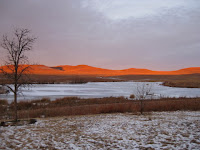 urned to West Virginia and received an hour of direct sunlight in the next three weeks. I never can convince my students that here in steeply hilly central West Virginia, I miss real mountains. But then, they have no idea what it is like to grow up in the shadow of Mount Evans (the image is of the view
  from the gas station near my parents' house. Even suburbia in the foreground does little to diminish the majesty of my favorite mountain).
 urned to West Virginia and received an hour of direct sunlight in the next three weeks. I never can convince my students that here in steeply hilly central West Virginia, I miss real mountains. But then, they have no idea what it is like to grow up in the shadow of Mount Evans (the image is of the view
  from the gas station near my parents' house. Even suburbia in the foreground does little to diminish the majesty of my favorite mountain).
Of course I am lucky in all sorts of other ways, from having friends who read my blog to having a warm house to clutter up, to having the Mister who will take me out for Valentine's meals of duck and lamb, to having a very very sweet very very silly kitten running around the house. 
Saturday, February 14, 2009
Science Novels and Novel Science
Most of the time I like knowing something about a book when I begin to read it. Not the ending or even necessarily "what it's about", but the kind of information I can usually glean from the cover, from  the tastes of the recommender or from knowing something about an author. Still, it was an unusual pleasure to read The Strange One by Fred Bodsworth without having any idea of what it was or where it was going. The cover offered few clues: the book handed to me is in its 1959 library binding. It looks like a dated library book, possibly young adult, with no words except the title, the author and "Withdrawn from San Bernadino County Library". My mother physically gave it to me, telling me my aunt had wanted me to read it because it was "about a botanist, or maybe not really a botanist" and that my aunt had cried the whole plane ride back from France as she finished it. The aunt in question has good taste in books, but usually recommends contemporary fiction (The Kite Runner or The Time Traveller's Wife) to anyone who reads. To my knowledge, she's never before singled me out for a specific book, nor has she ever been within a thousand miles of San Bernadino County.
 the tastes of the recommender or from knowing something about an author. Still, it was an unusual pleasure to read The Strange One by Fred Bodsworth without having any idea of what it was or where it was going. The cover offered few clues: the book handed to me is in its 1959 library binding. It looks like a dated library book, possibly young adult, with no words except the title, the author and "Withdrawn from San Bernadino County Library". My mother physically gave it to me, telling me my aunt had wanted me to read it because it was "about a botanist, or maybe not really a botanist" and that my aunt had cried the whole plane ride back from France as she finished it. The aunt in question has good taste in books, but usually recommends contemporary fiction (The Kite Runner or The Time Traveller's Wife) to anyone who reads. To my knowledge, she's never before singled me out for a specific book, nor has she ever been within a thousand miles of San Bernadino County.
The "all characters are fictional" disclaimer didn't shed any light on where the book was going, except that Bodsworth has a sense of humor, "It [the story] is a work of ficti on and all of its characters are fictional people-- except the goose, which is a fictional goose." The story promptly starts with the story of a Barnacle goose in the waters off the Hebrides, switches to a cocky grad student in Toronto and joins them together in a clever play on names. I won't reveal much more, except that it is not about a botanist: ornithologists are altogether different people, and that I did weep profusely enough about a goose that I've sworn off reading other sad books for a while. One hopes that the sad parts not about the goose are sorely outdated, and that race and class relations have altered fundamentally in fifty years, but I'm not sure I would have been crying if bigotry were all a thing of the past. Highly recommended for both mothers, and my many biologist friends who enjoy a touching story, even if many of the characters are abrasive.
 on and all of its characters are fictional people-- except the goose, which is a fictional goose." The story promptly starts with the story of a Barnacle goose in the waters off the Hebrides, switches to a cocky grad student in Toronto and joins them together in a clever play on names. I won't reveal much more, except that it is not about a botanist: ornithologists are altogether different people, and that I did weep profusely enough about a goose that I've sworn off reading other sad books for a while. One hopes that the sad parts not about the goose are sorely outdated, and that race and class relations have altered fundamentally in fifty years, but I'm not sure I would have been crying if bigotry were all a thing of the past. Highly recommended for both mothers, and my many biologist friends who enjoy a touching story, even if many of the characters are abrasive.
I picked up Ivan Doig's The Whistling Season the day after reading The Strange One and read it in a day as well. Doig's novel of childhood dryland farming in Montana in 1909 sparked comparisons to O Pioneers!, Louis Erdrich's Master Butchers' Singing Club and Ralph Moody's Little Britches stories, all of which are great in their own way, and which The Whistling Season can stand proudly among. I couldn't help but compare The Whistling Season to Buster Midnight, both being about Montana and boxing in the early 1900s, and for characters that feel authentic (even when they learn Latin in a one room school), Doig beats Sandra Dallas by a long way. My mother recommended The Whistling Season in part because it promotes one room and local schools as part of comprehensive education. I totally agree that great teachers can make a great difference and that students' education should integrate science and arts into spelling lessons. I can't help but think,  however, that Doig's character and my mother romanticize the possibilities of education in a small town. My fathers will quickly tell you that small schools in small towns more often mean being stuck with mediocre educators for years rather than learning from a brilliant integrated curriculum as Doig's character did. Strangely, the one thing that made me cry reading this was the descriptions of Halley's Comet, which I managed not to see in 1986, despite many attempts. Hale-Bopp, fortunately, was magical in the evening sky in Philadelpia.
 however, that Doig's character and my mother romanticize the possibilities of education in a small town. My fathers will quickly tell you that small schools in small towns more often mean being stuck with mediocre educators for years rather than learning from a brilliant integrated curriculum as Doig's character did. Strangely, the one thing that made me cry reading this was the descriptions of Halley's Comet, which I managed not to see in 1986, despite many attempts. Hale-Bopp, fortunately, was magical in the evening sky in Philadelpia.
In The Creation E.O. Wilson, "proposes an* historic partnership between scientists and religious leaders to preserve Earth's rapidly vanishing biodiversity" according to the back cover. Frankly, if Wilson intended to be persuade about the power of combined forces, he fails. Despite written claims to the contrary, however, I doubt this was the main purpose of the book. The final unit "Reaching Across" (subheaded "Science and religion are the two most powerful forces of society. Together they can save the creation.") fills only 3 and half pages of this slim volume, and most of those pages are spent refuting Intelligent Design as a scientific theory, hardly a compelling argument for a joining of societal superpowers. What Wilson does do well, however, is explain just how important biodiversity is biologically and as most of the book is devoted to this (in a guise of a letter to a Baptist preacher), I assume this was his primary intent. His suggestions for raising a naturalist are great and his ideas about teaching biology carefully considered. I was amused (bemused?) that, following the calculation that protecting the top 25 hotspots of biodiversity (protecting about 70% of land dwelling plants and animals) would cost the world $30 billion, Wilson went out of his way to explain how this vast sum of money could be found. The book, written in 2006, was obviously before modern congressional bailouts and only made me wonder why we didn't throw in another $30 billion to protect global biodiversity if that's all it's going to take. Should you be wanting to read why biodiversity is important and how the science needs to progress in order to preserve it, I recommend The Creation. While the book is respectful of religion, if you are looking for creative solutions to combine science with religion, look elsewhere.
*how silent to 'h's need to be to be preceded by "an"? "An hour" "an herbaceous plant" definitely, but "a heroine overdose" and "a histogram". In my pronunciation, historic and hysterical would fall on the "a" side, but I know of no official ruling (my English ex-boyfriend does not count).
Sunday, February 8, 2009
Beans! The Legume Resolution
I'm excited to announce that I am resolved to explore the world of legumes* in 2009.
Well, for one thing, I will eat more of them. I'll be eating favorites including black bean breakfast burritos and spicy red lentils, but also trying new beans eaten in new ways (to me). I've never cooked fresh fava beans, never tried sweet beans in my bubble tea, never experimented trying to make my own daal o r falafel and I haven't a clue which soy milks taste bad. I've purchased adzuki beans several times in my life and never once figured out what to do with them. That will change this year.
How, you may wonder, does one explore legumes?
Well, for one thing, I will eat more of them. I'll be eating favorites including black bean breakfast burritos and spicy red lentils, but also trying new beans eaten in new ways (to me). I've never cooked fresh fava beans, never tried sweet beans in my bubble tea, never experimented trying to make my own daal o
 r falafel and I haven't a clue which soy milks taste bad. I've purchased adzuki beans several times in my life and never once figured out what to do with them. That will change this year.
As a botanical family, beans are interesting beyond the edible parts. I hope to do some legume gardening and some legume tourism as well. Possibilities would include the prairie in bloom with baptisia, gardens of the South overflowing with wisteria, the Texas hill country when the blue bonnets are out, the desert with mesquite or a safari among acacia trees. None of these trips are planned, by the way, but as one of the largest plant families, I'm sure to find legumes to observe in Italy and here in my own garden, two trips I am planning on making.
Beans have made their way into literature. I'll be rereading The Milagro Beanfi eld War and The Bean Trees, and looking into Jack and the Beanstalk and other magic beans. Happy Cricket recently informed me that Thoreau was interested in beans, so it appears I'll be looking into Walden for the first time. Other suggestions are most welcome.
 eld War and The Bean Trees, and looking into Jack and the Beanstalk and other magic beans. Happy Cricket recently informed me that Thoreau was interested in beans, so it appears I'll be looking into Walden for the first time. Other suggestions are most welcome.
Finally, I'll be writing about beans as well for other forums. Prairie turnips, Pediomelum esculentum, my favorite dissertation study organism, are legumes (not turnips) and its high time the world learned of them through some peer-reviewed articles in ecological journals.
So, legumes, here I come. They, are, as the rhyme goes, good for your heart.
*The legumes, correctly the Fabaceae are a plant family typically known as the "peas and beans". The family includes beans (green, black, red, navy, white, cranberry, pinto, kidney, soy, wax, string, runner, long, broad, fava, anasazi, adzuki and garbonzo), peas (green, sugar, split, chick, and poisonous sweet), peanuts, lupines, prairie turnips, indigo, mimosa, mesquite, red buds, golden banner, wisteria, locust (honey, black and new mexico), laburnum, vetch, clover, alfalfa, gorse, broom, and locoweed, among many others.
Saturday, January 24, 2009
Quiet and Not-So-Quiet Books
One of my sisters-in-law suggested I borrow A Visit to Don Otavio by Sybille Bedford when I asked her for "fun thoughtful book" ideas. The book chronicles Beford's year in Mexico post World War II. At times it feels dated and at times I plodded through the historical descriptions unsure if didn't want to read them just because I am historically ignorant or because they disrupted the pacing of a generally charming book. Overall, however, it felt true. Highly recommended for anyone who has  travelled in places not set up for travellers. Having never been to Mexico, I was reminded of Christmas in China with my parents. Bedford captures the emotions (and humor) of travelers being a novelty at someone else's command, be it the overbearing neighbors insisting on a lunch visit or the forces that operate the trains, allowing one no escape except to catch the train from the day before yesterday.
 travelled in places not set up for travellers. Having never been to Mexico, I was reminded of Christmas in China with my parents. Bedford captures the emotions (and humor) of travelers being a novelty at someone else's command, be it the overbearing neighbors insisting on a lunch visit or the forces that operate the trains, allowing one no escape except to catch the train from the day before yesterday.
A Visit to Don Otavio struck me as an obvious predecessor to Peter Mayle (A Year in Provence) or Frances Mayes (Under the Tuscan Sun), and, for that matter, with her fantastic description of a hamper for travelling, of Amanda Hesser, but while Bedford occasionally neared the point of my wanting so smack her upside the head (which was a repeated reaction of mine to Mayle and Mayes) she never quite hit it. Perhaps this is because I let historical snobbery get away with a bit more than contemporary snobbery, or perhaps because, unlike Mayle and Mayes, Bedford never claimed this was paradise and then tried to change it, but most likely because Bedford can, and does, laugh at herself. After sending back a bottle of Mexican wine (which the server did not find lacking) she is annoyed at the waiter's insistence on replacing it was a bottle of imported wine. "I choose a Spanish claret . . . It is good, but it costs ten shillings a bottle, which is too much to pay for one's glass or two at dinner in a wine country. Perhaps, it begins to dawn on me, Mexico is not a wine country."
Bedford has the pleasant habit of starting every chapter with a quote and the annoying habit of not translating them. Somehow I would be okay with that if they were in Spanish, but most are French, with a few German. If Bedford were a contemporary writer, I would accuse her of being a Eurosnob.
Eudora Welty is very far from being a Eurosnob. She is among the writers I've long known  existed and thought I wanted to read (Flannery O'Connor, Joyce Carol Oates, and George Sand being others) but couldn't name a single work of hers until one ended in my lap at Christmas. Deciding that I needed more fun, thoughtful books, my sister-in-law gave me four such books (she presented them with great trepidation, as if I might not love a gift of four books loosely themed around women and their gardens. Said sibling-in-law is an occasional reader of this blog, so I feel I should declare for her, the record, and anyone else possible tempted to give me interesting books: by all means, give me books! Do not be offended if they do not float to the top of my to be read pile, but I will read them and will delight in the idea that you gave me a book), Eudora Welty's The Optimist's Daughter among them.
 existed and thought I wanted to read (Flannery O'Connor, Joyce Carol Oates, and George Sand being others) but couldn't name a single work of hers until one ended in my lap at Christmas. Deciding that I needed more fun, thoughtful books, my sister-in-law gave me four such books (she presented them with great trepidation, as if I might not love a gift of four books loosely themed around women and their gardens. Said sibling-in-law is an occasional reader of this blog, so I feel I should declare for her, the record, and anyone else possible tempted to give me interesting books: by all means, give me books! Do not be offended if they do not float to the top of my to be read pile, but I will read them and will delight in the idea that you gave me a book), Eudora Welty's The Optimist's Daughter among them.
Pulitzer Prize winnng The Optimist's Daughter is a small, quiet book. I caught myself regularly comparing it to Willa Cather works and, like The Professor's House, never could decide if too much happened or nothing much at all. I read it too quickly, for I am a fast plot reader, and much of the beauty of small quiet books is in the details fast readers don't catch. Still, I caught enough detail to consider it lovely and refreshing. Well worth reading for those of you who also consider emotional reactions acceptable plot-forwarding action.
In the last two weeks I've also read some trash: Sandra Brown's The Silken Web and Katherine Greyle's Miss Woodley's Experiment. The former is a contemporary romance (first written in 1982 and revised in 1992) and the second a regency romance of the type where they can, and do, have sex. While The Silken Web had a real emotional tangle way too conviently solved, way too much almost sex and fighting about it, and too many obvious communication failures (cell phones would ruin the plot), it still managed to be a sexy tear-jerker. Miss Woodley's Experiment was nothing extraordinary plot-wise, but the heroine was just quirky enough to make me want to seek out Greyle similar works at some library book sale sometime, while I won't be looking for any more Sandra Brown.
Tuesday, January 20, 2009
Buying Britches
Having had trouble buttoning a pair of pants on Friday, I went to the mall (not an easy feat where I live) on Sunday and bought two new pairs.
The circumference of my waist did not decrease over the last 2 1/2 months, but then, I am also twelve weeks pregnant, so I am not particularly concerned.
My final weight for the school program was -1 pound and the final weight for my personal program was -2, although I did not reach my goal of fitting into all of my pants or being on the lower side of a pychologically major number of pounds.
I'm still sending my $50 donation to Feeding America. I'll leave it to you to decide if you go by letter or spirit of the challenge and still want to make a donation (I'll add that there are plenty of people needing food regardless of my size, but I fully understand not supporting a personal challenge when the terms weren't met). Note in the comments if you still want to give and if you want to give directly (link above) or if you want to give through me (only advantage being that you wouldn't be on the mailing list, and I already am).
The circumference of my waist did not decrease over the last 2 1/2 months, but then, I am also twelve weeks pregnant, so I am not particularly concerned.
My final weight for the school program was -1 pound and the final weight for my personal program was -2, although I did not reach my goal of fitting into all of my pants or being on the lower side of a pychologically major number of pounds.
I'm still sending my $50 donation to Feeding America. I'll leave it to you to decide if you go by letter or spirit of the challenge and still want to make a donation (I'll add that there are plenty of people needing food regardless of my size, but I fully understand not supporting a personal challenge when the terms weren't met). Note in the comments if you still want to give and if you want to give directly (link above) or if you want to give through me (only advantage being that you wouldn't be on the mailing list, and I already am).
Subscribe to:
Posts (Atom)


 Posts
Posts

