Showing posts sorted by relevance for query may day. Sort by date Show all posts

Wednesday, May 1, 2019

May One

The first of May is somewhat of a big deal to me.

Growing up, on the first of May I dropped paper baskets full of dandelions on our doorstep, and every so often as an adult send May baskets to friends. One year I made a May pole in my basement.  I consider it the start of my favorite month of flowers and celebrations. 

The first of May marks the beginning of Pediatric Stroke Awareness Month and I often alert folks to the Childrens' Hemiplegia and Stroke Association (chasa.org) and the fact that kids have strokes, too.

The first of May often coincides with the beginning of the end of the college school year (I'm giving a final tomorrow and one Friday, and graduation is Saturday!) and has become the time I catch up on phenology: I can usually report when the Mississippi Kites arrived (not yet!) and can compare flower seasonality because I post an image of big bouquet each year.

Things have felt odd this week.  It has been a gray and drizzly-- exceptionally spring-like and completely out of place for Western Oklahoma.  Monday I gave a final to one of the best group of students I have every had, with tears and thank-yous and graduation announcements exchanged at the end.  Meanwhile I'll be pleasantly surprised if all of the students make it to Friday's final in a similar-sized class.  My institution's fabulous Dean of Students, the woman who assured every student, parent of student, and faculty member, that she would help with their problems, and that she had chocolate in her office if she couldn't herself be of help, died.  I learned of her death yesterday through an awkward e-mail.  Later in the day I learned that the provost's father and Dianthus's PE teacher's husband died and that there are lots of roles needing filled during end-of-year stuff at our schools.

Given my renewed proclamation of my witchy nature and pagan tendencies (a quick "May Day" search of this blog will demonstrate that my love of May Day long precedes witch year), today I felt I needed a May basket, but I was thinking of death as I glumly walked through the wet grass looking for flowers. I picked the iris and bachelor buttons along the alley and peaking out of a kids' digging area overgrown with honeysuckle and vinca were giant fluffy peonies.  They are along a warm south facing wall in an area that isn't seen, so I didn't feel at all bad about picking them.

I found a real basket from a dear friend.  I gave myself a self-inflicted challenge of arranging them in the basket rather than in a vase. I lit the sun and moon candle from Carrie-Ann, my moonbeam (I was her sunshine) who died in September and suddenly we were all there: friends near and far, mother and grandmothers, witches, flowers; light, gray, dark, life, and death, sun and moon.  Spring Re-birth.
And because I'm a product of my time, I snapped a photo, blew out the candle, posted the picture on social media and rushed my sons to their evening activity. 

So May One feels a little more this year.  It reads like the start of some blessing for which I haven't had time to prepare an end:
May one look out for the birds that are bound to come through.
May one recognize that pink fluffiness is transient, but that doesn't make it any less real.
May one light the candles of friendship.
May one remember that death calls us all.
May one recall that just as winter comes, so does spring.
May one always have a colleague with chocolate in her office and may one be the bearer of chocolate when needed.

May one have a great May.

Sunday, January 27, 2019

Thoughts a Sennight Before Imbolc

I have not become more of a witch this year.

Between visiting Salem and staying with a friend with spell books over the summer, it became clear that that sort of witchcraft is not my thing.  And while the year has been emotionally taxing and politically frustrating, my personality is just not that b sort of witchy.
C-A July 2018.  Love is stronger than any craft.

After my dear friend C-A, the friend who had responded with such love to my initial post about witches ["I see the witch theme as having more of a sacred relationship to nature and a focus on the magical essence of life.  Maybe we can collaborate on some ideas for focuses through the year?"] died in September, before we had a chance to collaborate on discussing the sacred relationship to nature, I was nearly ready to stall the pursuit of witches indefinitely.

Yet by December, the seasons had changed again.  I had been given A Discovery of Witches and the rest of the All Souls Trilogy right after I picked up Harry Potter again, and I started reading novels of witches back to back (with a feminist space opera interlude for K.B. Wagers's Beyond the Chaos).  I just finished A Secret History of Witches this morning and pulled out Ellen Dugan's Garden Witchery to figure out what herbs to feature at the upcoming groundhog party.  The groundhog party has become my place to start or end themed years, as with last year's ten pie graduation, and I had already planned on lots of witchy touches to the party: candles, flowers, a cauldron of dry ice punch, flaming torches and the subtitle "A Summoning of Spring"

I flipped open Garden Witchery to the page about the sabbat of Imbolc.  The book, written by a suburban Missouri gardener, has practical family rituals for each of the eight pagan celebrations of the seasons.  Imbolc became St. Brigit's Day became Candlemas became Groundhog Day.  It is halfway between the solstice and the equinox, the time when days really are noticeably longer, when the weather of winter may be fierce but there are cracks in the grip of winter; it is clear that spring will comes.  For Imbolc, Dugan suggests arranging some flowers and candles in the house and then getting outside to watch the sun and do something observing nature, like taking the family to a wildlife refuge to look for eagles.   This sounds familiar.


Not my natural habitat
From all my recent reading, I've learned that witches celebrate the solstices and equinoxes (yep, I've thrown parties for those) and days in between: Imbolc/Groundhog Day as the light returns, May Day/Beltane, the harvest, and Halloween.  I've thrown parties, baked, and lit candles for those as well (many recorded on this blog).

I have been a gardener all of my life.  I wrote my 5th grade research paper on "Medicinal Uses of Herbs in Colonial America."  For 4-H Creative Cooks contents I proposed menus for May Day (with baked lemon bread), Midsummer's Eve (a lemon fool with blackberry sauce), comet watching, and the spring equinox (with a blueberry and kiwi yin-yang tofu cheesecake).  I started sending out Groundhog cards in 8th grade reminding friends to celebrate the season, whatever the season is, and my first party was 25 years ago.

So I haven't become any more of a witch.
I've always been one.

Thursday, May 1, 2014

May Day kicks off the Streak for Strokes

Happy May Day!
May your life be filled with spring and flowers rather than Soviet military maneuvers or last ditch distress calls.
May is Pediatric Stroke Awareness Month, and, as with many of the other parents part of CHASA, I'm doing a streak for stroke. Streak for Stroke has been going on for many Mays now, and the nice alliterative phrase has been used to mean many different things, from streaking ones hair to planting a streak of purple flowers, but most commonly used for doing things consistently-- getting a winning streak going.
Pediatric Stroke Survivor and Big Brother Dye Easter Eggs 2014
So, during the month of May, I'm going to blog up a storm, and keep a streak of blogging five days a week for the month.  My intention is that once a week I will write personally about raising a kid with hemiplegia, once a week I'll write (or link to) information about pediatric stroke research, and the remainder will be my normal blog posts-- roots, flowers and books.  I have one guest post lined up by an adult with cerebral palsy lined up and would love to hear of your experiences with strokes, special needs children and cooking with roots.
Please check back often, ask questions and comment.  I'd love to start a discussion and I'm hoping to post often enough that I'll respond in a timely fashion. 
Someday I may even answer the obvious question: why do we need to raise awareness (and money) about pediatric strokes?
But until then, enjoy the flowers. 


Sunday, May 1, 2016

May Day Streaking

Happy May Day!

At Saguaro National Park, May 15 2016
I am again going to celebrate my favorite month by blogging a streak (20 days this month) to raise awareness for pediatric stroke.

And during this streak for stroke, while I will talk about pediatric stroke, my favorite pediatric stroke survivor, and how CHASA helps families of kids with strokes, I'm going to post pictures of flowers and talk about birds because that's what I do.

Come back often, and in the meantime, celebrate the season!

Thursday, May 1, 2008

Happy May Day


Happy May Day. Flowers and spring are always lucky. Distress signals and Soviet demonstrations, not so much.

Monday, May 3, 2010

Tres de Mayo

In May 2008, spring was advancing at a pace about a week and a half behind this year, judging by the dogwood, lilacs and early azalea in that may basket. All of those flowers were well past when I picked a different lavender azalea for this year's bouquet.

Monday of Finals 2009 (May 4) we flooded. This year it rained all night but the river creseted at a mere 16 and a half feet.

On May 3, 2003 I met the Mister for the first time.

May 3, 2010 Dianthus has an ear infection and was sent home from day care, so my to-do list is looking more like that of May 3, 2009 than I'd like to admit, except there is no going to Italy at the end of it and I'm not sleeping well because of a cranky baby on the outside, not a hiccuping fetus inside. On May 3, 2010 the forget-me nots, clematis, columbine and alliums are looking great.
May is the luckiest month.

Saturday, May 9, 2015

The Pilgrims are coming!*

Running to the Farmers'
Market in the FOG.
May 9, 2015
We followed indoor graduation procedures this morning because of the fifth day in a row of real rain.  One of my graduating seniors commented that she doesn't remember this much rain since, well, ever. During a downpour in late April, a new faculty member asked, hopefully, "They say that spring is the rainy season here?" to which I had to respond, "This is my fifth year here and I haven't experienced a rainy season."
Two weeks later and I have now experienced a rainy season. The local paper reports that we haven't had this much rain in a 30 day period since the 1920s.  Last week's drought monitor had us downgraded to "severe" drought (and who knows, by Tuesday our drought might just be "moderate").

Even before the recent deluge, it was a great year for the roses all over town.  Peonies were blooming places I've never noticed them and mine are finally growing up.  I claim not to be a rose person or a pink person or a frilly, fu-fu person, I make exceptions for bouquets of May flowers**.  Images are of a bouquet I picked Tuesday, May 5 and took to Texas.  I also picked one here yesterday, that includes additional deep rose-colored peonies that are just starting to open.

Happy Rain!  Happy Flowers!

*"If April showers bring May flowers what do Mayflowers bring?  Pilgrims!"

**While I still have no images of my famous former peony parties, one can see images of my May flower fanaticism with peonies up close,  or a big West Virginia bouquet.

Monday, May 3, 2021

Kites and Flowers

 I was walking to work this morning (Monday, May 3) and thinking how odd it was that I haven't seen a kite yet.
I walked home at 10:30 and there were 12 on the power lines in one alley.  
Two friends around town mentioned seeing single kites over the weekend, and they certainly aren't ALL here yet, but I would argue that they truly arrived approximately 9 am this morning.
(In 2020 I saw 2 on April 30 and then a larger bunch on May 1.)

In my other annual phenology update: here's my May Day bouquet (actually picked on May 2).  The peony is the only peony currently in flower (from against a south-facing brick wall), the irises are at about peak, and none of the roses, honeysuckle, or mock oranges is blooming yet.  The wheat is from the growing wheat patch (last year I baked a loaf of bread from it).  My next career might be growing grains for the florist industry.  The Mister suggests that might not be much of a career, but one can hope.


Sunday, June 1, 2014

$55 shoes: On Money Weirdness and the Cost of Cerebral Palsy

People are weird about money.  People are weird about lots of things,  but I am still surprised by how widespread weirdness about money is, among people who have it and people who don't.  And, unlike sex and death, about which people are also weird, money needs to be dealt with on a daily basis and people tend to be much more open with their opinions on the weird money habits of others. Which is one of the reasons why putting together a post about the financial aspects Andrew's diagnosis has been hard for me. Some of you would buy the $55 shoes without batting an eye.  Some of you would buy three more pairs of ill-fitting shoes while waiting for the $55 shoes to go on a great sale and then buy an un-tried $25 pair of the same brand because the company is then out of the $55 shoes.  Some of you never have a choice to buy the shoes.  Some of you think that I am asking you to buy the shoes*  And it's not really about the shoes.

But the shoes are an illustrative example, so I will start there. Aster currently wears a small, relatively simple, AFO (ankle-foot orthotic) every day.  It helps stabilize his gait and prevents him from toe walking or tripping on his toes some of the time.  He started wearing this AFO daily in January, about the same time he started wearing a pair of Pedipeds that I had purchased in some great Internet sale back in November.  The shoes fit well: they have removable inserts so that his left shoe is sized probably a whole size smaller than this right, they have a deep toe box and, while wide, can be secured snugly.  They also have great flexible soles and a reinforced toe that has not worn through in several months of constant wear. Two weeks ago he soaked his shoes in the sandbox and we realized that the other shoes we own that fit him don't fit the AFO.  I looked up Pedipeds on-line and found that they may not make the exact same shoe anymore, but one that is at-least visually similar runs $55 a pair.
I didn't click through and order them.
I don't spend $55 for a pair of shoes for a not-yet-three year old.

This is where the weirdness comes in with attitudes about money and if you want to argue with me about why it is a great deal (i.e. they last longer, fit better, and I don't have to buy two pairs.  Besides, have I looked at the prices of shoes recently?** ) or why I should wait until after the summer or next pt appointment or new AFO, feel free.

The thing is, I'm just not ready to add "special expensive shoes for life" to the list of extra expenses Aster's condition requires.  I've already mentally budgeted for the full $1,000 deductible and then some for health expenses every year.  I'll pay co-pays for appointments and drive to "The City" (or Denver, Dallas or Kansas City where there are physiatrists) when necessary.  I'm figuring out how to get him to and from the three-year-old preK program next year, which will probably require paying extra help.  If he needs a new AFO or constraint cast, I'll buy it, and if we become convinced that botox is necessary, we may very well pay for that out of pocket.

But somehow adding expensive shoes to the mix feels like too much and it feels too permanent.  (I told you people are weird about money.  I'm including myself here.) If I have other CHASA parents reading this, they may be laughing uncomfortably at my balking about the shoes when they have EEGs, sleep studies, seizure meds, custom orthotics, wheelchairs, remodeled bathrooms to they can get the kids in and out of the bath . . . but we all have a level at which rationality leaves us.  I think the shoes bothers me so much because it symbolizes an abandonment of the normal.  Medical expenses are additions to normal expenses. Having to buy special shoes, and possibly two pairs of them at a time, means that there will be none of the normal.  Options will always be limited.

Along with the time, the costs of limited options may be the most demoralizing (at least for those of us who have not suffered lengthy hospitalizations and can pay the direct costs as they occur [a CHASA blogger whose son seems about as affected as mine calculated over $10,000 annually in expenses; we haven't seen that yet but see how it could happen]).  Aster can't use Dianthus's hand-me-down pants much longer because they have buttons and zippers (and potty training attempts are useless unless Aster can pull down his own pants).  Aster may have fewer choices for instruments and sports he plays, jobs he can take and ways in which he can travel. It's not as if those of us with good bilateral movement have unlimited choice in these things. Kids in small towns don't play orchestral instruments; I don't have the ears for trombone or the body for modeling; and even the Mister and my brother don't have exactly what it takes to make it as theoretical physicists; and we all survive(d) it just fine. But it is still discouraging that Aster's options may be*** limited before he's three.  The cheap option always goes first.  And one is left contemplating $55 toddler shoes.

I'll end there.
Hopefully someday I'll get around to blogging about other costs to parents, but for now you can at least follow the thinking (and envision a photo of Aster and his shoes).  Parents have limited options in jobs they take because of insurance, because of needing flexibility for taking a kid to therapists and specialists; because of difficulties finding help and even because services vary so much state to state (and sometimes school district to school district) that sometimes moving is out of the question and sometimes it is a necessity.  [The Mister and I are currently very fortunate in those regards.]

*I'm not asking you to buy the shoes.  I am however, asking you to consider donating to CHASA so that parents who definitely need the shoes in two different sizes can exchange shoes successfully.
**and I have now, and the a new recommended option from the CHASA parents costs $55 and I saw the recommended Nikes at the outlet mall on a great special for $44.  I will admit to being "out of it" when it comes to pricing.  I was shopping in Colorado last year when my dear friend kept pointing out cute, reasonably priced kids clothes. "$12!" I thought, "that's 24 times what I normally pay for the boys' shirts!"
***and may not be.  One of the reasons that one bothers with all of these procedures and therapies is that near-normal functionality may be achievable.  There's just too little known about pediatric strokes and brain plasticity to predict in any meaningful way.

Sunday, February 3, 2008

Three-Glass-Breaker Party

I'm pleased to report that this year's groundhog party was a great success, despite us managing not to play pin the shadow on the groundhog. Attendance was low, partially due to "crud" that we blame our students for passing around, partially due to many concurrent obligations and in one case due to the friend having previously been invited to another groundhog day party! Despite the small turnout, we had a very good time and copious quantities of blue groundhogs were consumed.

In my book, all parties are lucky because they force me to clean the house (an all-day operation yesterday for both of us) and because they allow me to bring out silly and sentimental stuff. In this case, I had Chinese good luck wall hangings from my host family in Taiwan in 1989, Chinese objects from my parent's stay in Nanjing, bright orange dipping bowls I inherited from my neighbors, hedgehog napkins from a best friend, new partyware from prairie quilter, and tasty Christmas present treats (including sugar mice that the six-year-old loved, much to his parent's chagrin) beyond the usual groundhog tattoos and drink umbrellas.

We ate jiaozi which are lucky for the new year because they are little moon bundles of prosperity, along with sesame candies and various sweets in order to have a sweet new year. One attendee brought oranges (from her parents from Florida) having researched that oranges are the proper treat to represent a prosperous and plentiful new year. This struck me as particularly lucky because it indicates this woman is the kind of person who will look-up odd-ball traditions for a party (and she wore her red silk pajamas commenting as she walked in, "red is the lucky color for Chinese New Year") and could become a real friend. She also guessed the last snow would be in exactly six weeks because Freddie (WV groundhog) saw his shadow. Perhaps she'll turn out to be a kindred spirit, and definitely someone to talk to about luck and fate.

Because we were celebrating the upcoming new year, we discussed Chinese zodiac signs. Learning that a friend is a fellow rat (but not my age) explained a great deal about her. I almost burst out, "No wonder you are constantly justifying your choices [marrying and having a baby immediately after finishing her masters and currently not working with a six week old baby] acting weird about jobs and status, and apologizing for references you don't get: you're 23!" I don't like falling into the smug elder role, but I am in this case. I think I can better accept youthful insecurity than just plain insecurity.

Late in the evening (or early in the morning), three glasses were broken. One beloved blue wine glass went down when a woman elbowed the glass while her husband was holding it. Impressively sharp elbows. One martini glass and one whiskey glass toppled and shattered with a bunch of mini-candy canes. Somehow I think that breaking glass is auspicious. This may have something to do with Jewish weddings or German polterabends, may be from Huey Lewis and Billy Joel* songs, or may be from The Mister breaking a glass at the first of my parties he attended (about our fourth date) and commenting, "It's not a party until someone breaks something." This statement, along with his smooth cleaning up of the glass, completely endeared him to Tuscon Trekker, my roommate, who was known for dropping dishes. It was also repeated at our wedding when our one of our glorious two foot tall champagne glasses snapped.
Three glasses broken: it was a good party.

Still, I missed all of you.

*"I like the sound of breaking glass. If you don't believe me, why did you ask," from "I know what I like" and the intro to "You May Be Right" includes a fabulous shattering before, "Friday night I crashed your party, Saturday I said I'm sorry."

Last year you could apparently learn to make jiaozi like those pictured at the Asian Cultural Center of Vermont.

Tuesday, May 23, 2017

None of it Hubig's

The Mister and I prepared for our recent excursion to New Orleans by watching Anthony Bourdain talk about food in New Orleans which led to watching the HBO series Treme*.  From Treme I learned about Hubig's Pies, little fried hand pies available at convenience stores, which helped everyone feel back at home after Katrina, and immediately added them to my list.  Alas, the Hubig bakery burned down in 2012 and is not being rebuilt, so I did not have a Hubig pie.  But I did have some great ones.

Our first night we ate the best piece of pecan pie I have had (and I don't say that lightly) at Brigtsen's  (actual pecan pie recipe here).  Somehow placing the slice of pie in a pool of caramel sauce enhanced it and didn't make it too sweet.  It was the perfect conclusion to a near perfect meal including sweet breads, soft shell crab, rabbit, and oysters.

Our third night we had a disappointing chocolate pudding pie after an otherwise phenomenal meal that included head cheese, crawfish pie, boudin balls, and oysters at Cochon.

Somehow the day in between included neither oysters nor pie, although it did include two variations on sno-balls (not the same as a snow cone), one after kayaking on Cane Bayou and one as a bonus course in the homage-to-foods-New Orleans tasting menu at Coquette.

I did not see them until the airport (and after I had bought the boys over-priced pralines), but once I identified them, I knew I had to carry home the Haydel's New Orleans Hand Pie Hubig replacement (although Haydel's are baked and not fried).  We split the cherry and the coconut cream six ways when we returned, and they were tasty enough, although nothing for which I will return to New Orleans.

7, 45, 5  May 20, 2017
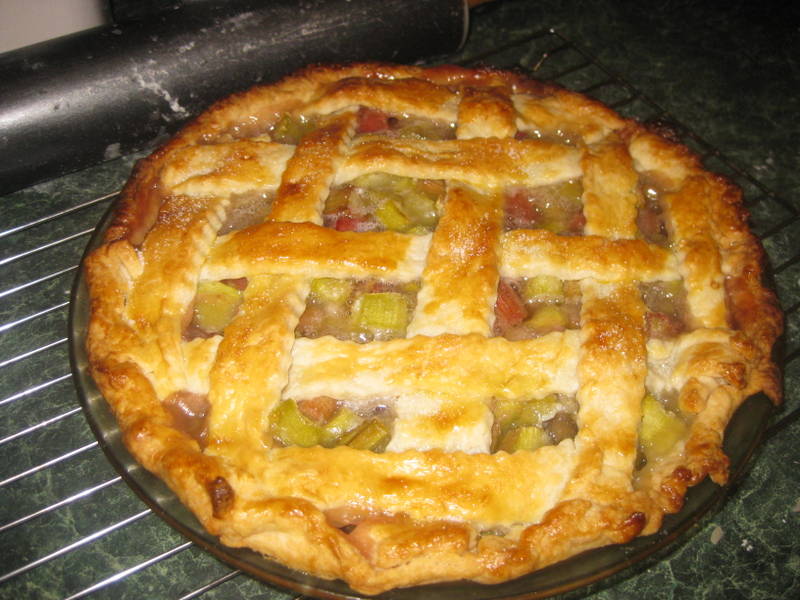
Also, upon our return, Aster and Dianthus presented me with a birthday chocolate tart with a pistachio crust baked by my mother and then my mother and I celebrated Mother's Day together a week late by baking a rhubarb pie (following the Magpie crust and the Art of Pie filling thickened with a little tapioca).

So I'm another year and seven pies wiser (and experienced in all kinds of things, from packing by candlelight under a tornado watch to kayaking to changing transportation plans because of the Lee statue coming down in Lee Circle) than I was last week, and my small basement tornado shelter has now been used (by my parents and my sons).

It's a good adventure.
Rhubarb from Colorado May 2017
I plan to use this photo of my lovely mother
for the People of Pie series, but just in case I never
post that series, you can see how great my mother is.


*I am aware of the irony/condescending privilege/silliness of learning about tragedy, resilience and  and soul from watching an HBO series before a three day trip with every meal planned out. None the less, I appreciated the town a great deal more from having watched and learned.

Monday, March 17, 2008

Confused Irish Luck

Today is St. Patrick's Day. I am wearing green, but it's olive. The Mister and I cooked corn beef and cabbage over the weekend. Traditional or not, I deem it lucky because we like it (and the cabbage, at least, is good for us).

I set out this morning to write about clover vs. shamrocks. As I knew it this morning, clover is a big genus (Trifolium sp.) of legumes whose leaves are only lucky when found with four leaves. Shamrocks, on the other hand, were a three-leaf symbol of Irish Catholicism to be found in genus Oxalis in the Oxalidaceae (sometimes known as wood sorrel). I knew this is part because I sold shamrocks at garden centers for years.

Alas, I may have sold incorrectly.

Several Irish blogger make fun of Americans with their "shamrock" houseplants, and the hot debate among Irish botanist bloggers is which species of Trifolium is the "true shamrock". "Shamrock" appears to be a derivative of the Irish for "little clover." So shamrocks probably aren't oxalis. As a symbol of Ireland, shamrock's must have three leaves to represent the trinity that dear Patrick introduced to the pagans of that isle. If shamrocks are just clovers, there may be more to the idea that a four leaf clover is related (luck tradition-wise) to Irish culture and shamrocks. I had always been indignant that the Lucky Charms leprechaun was clearly Irish but was advertising four-leaf clovers instead of three-leaf** shamrocks


If clovers weren't confusing enough, then there's the luck o' the Irish. The Mister thinks that having the luck o' the Irish is to be lucky. I had always learned that having the luck o' the Irish was to have misfortune, perhaps always to come out okay (or at least drunk). If things were looking truly up, the luck o' the Irish would ensure something bad would happen to keep the good from getting out of hand. A quick internet search reveals that as to descriptive meaning, we are clearly both correct as there are Irish-Americans who use it to mean good luck, bad luck, mixed luck, and the good fortune to get drunk whatever one's luck. As to what luck of the Irish "should" mean, I didn't read anything authoritative enough to find out.

Oh, by the way, I'm part Irish. I think that's lucky. That my Irish great-grandmother was an Ulster Protestant I think may diffuse the luck a bit, but I ignore it on St. Patrick's Day.

All images on the left are labeled as trifolium and those on the right as oxalis.

**Would a gentle reader instruct me on a point of grammar and let me know if I should be writing about "lucky four-leaf clovers", "four-leafed clovers", "four leafed clovers" or "four leaf clovers"?

Tuesday, January 29, 2008

Resolved: A Year of Luck

In 2008, I am exploring luck. There is a lengthy justification for why I am choosing luck and how I came to decide on it (there is a rationale, although it may not be truly rational). Someday if it still interests me, I may write down said lengthy justification.
In the meantime, know that in 2008 I will be doing the following things at least once a month:

  1. eating a seasonal luck-bearing food
  2. learning about something thought to change luck
  3. helping somebody else improve his or her luck

Over the course of the year, I will also be exploring lucky media and hope to visit some luck bearing locales.

What does this mean in practice?

In January, for instance, I ate black-eyed-peas on New Year's Day to bring me good luck, I befriended two black cats and I hope to write about that, and allegedly two of the tubes of toothpaste I donated to community resources this morning have already been given away to make someone's day.

In February I will be eating special dumplings for the Chinese New Year, figure out what it means to be a clever rat in the year of the rat in the auspicious year 2008 and may read Alice Sebold's Lucky or Newberry Award Winning The Higher Power of Lucky.

As a supporter of my resolution, you can find me lucky foods, fun superstitions, things with "luck" or "charm" in the title or information about lucky traditions. I will be avoiding anything meant to improve luck by hurting someone else, pyramid schemes and chain letters and anthing obviously sacred or stupid.

I will also persist with old resolutions and quests. In 2008 I will:

  • continue in the quest to drink wine from every state and sparkling wine from all over the world
  • read and share interesting books
  • share seasonal vegetable recipes
  • write interesting things about rodents as I learn them.

I'm looking forward to learning what's lucky for you.

Monday, May 26, 2014

Friends, finances and other casualties

Dr. Darla Clayton blogged about how raising a special needs child destroys one's friendships.  I have not found this to be true.  I didn't have any friends locally before I became pregnant with Aster so there were no friendships to be destroyed.
"Wait," you protest, "I'm your friend."  Of course you are. And you were either a friend from some earlier (e.g. childless) time in my life or you are a virtual friend.  Chances are I have not hung out with you recently.
I moved from a small town where I didn't know anyone to a bigger small town where I didn't know anyone when Dianthus was one.  I immediately started a demanding job and then shortly thereafter became pregnant, so tired that I watched Wheel of Fortune every night and worried that I would fall asleep before the one year old (see some of the posts labeled "Rutherford Robinia").  At 42, I'm a full half-generation older than most of the day care moms.  I'm a generation younger than the women at the Christian Women's Fellowship group at church.  My friendly colleagues go out every Friday.  It only took once of laughing about the idea of, spur the moment, getting home, getting a sitter, magically feeding and instructing the sitter, not seeing my kids for the day and spending the evening with colleagues, before they quit asking us to join them.  But losing time with one's friends is a typical symptom of parenthood (A Morning Grouch describes it well here).  I've found it far more pronounced with two than with one (and I crave, more than about anything, a friend that I genuinely want to talk to with kids the age of my kids who can totally understand the necessary constant interruptions), and I hope that I am not losing my long-distance friends long-term just because I don't have blocks of time to talk longer than fifteen minutes and I so cherish my sleep.
Anyway, I don't think Aster's hemiplegia diagnosis has done disastrous things to my friendships, but as I read the stories of other CHASA moms, I understand how it could have.  Many pediatric stroke survivors have more issues than the poor use of limbs that Aster has.  When kids have sensory or behavioral problems, may or may not be communicative and may have seizures, it is really hard to take them any place, and almost impossible to find (or pay for) good sitters.  Some mothers of hemi-kids* hate being around other kids the same age because it emphasizes just how far behind the "hemi-kids" are.  Some worry that other kids will make fun of their hemi-kids.  Some worry that their sensory-seeking hemi-kid will bite.
And then there is the time.

One CHASA mom recently added up that she spends 27 hours each week with activities just related to the hemiplegia diagnosis (appointments, special classes, at-home stretching, therapeutic activities and the like,  I don't know if she included arguing with insurance billing or advocating for special ed. or not).  While I do not spend anywhere near that, the time beyond what a "typical" child takes can be costly.  It can take a toll on friendships, time with siblings, and financially.

More on the financial costs later.

Thanks for being my friend and for still being my friend if I didn't thank you properly for your last gifts, if I haven't called you in forever, or if I cut you off last time we did talk because my sons were in a "Baby! Baby! Baby!"  "No, you're the baby!" "I'm not a baby, you're the baby!" shouting match.

*Apparently the first name of CHASA was "Hemikids" but the connotation these children are half-kids was a little off-putting,  It is the term of choice on the facebook feed, but it does give me pause.  Of course, I wonder, if Aster is half young goat, what's the other half?

Monday, September 3, 2007

That Local Diet That Everyone's Doing


Dirtdog, my dear friend of 21 years (ack! We're getting old. People born on the day I first saw Dirtdog walking into my freshman physical science class and thought "Please don't sit with me, nerdy boy with the strange hat," can now legally buy alcohol in all 50 states.) mentioned something about that "local diet that everyone seems to be doing" as we were drinking New Glarus, WI beer, grilling Waunakee, WI brats with Waunakee, WI mustard sitting in on a deck in Waunakee, WI. Certainly there are signs that locavore lifestyles are proliferating among people of my acquaintance. One sibling's family belongs to a CSA, the other buys wondrous arsenal cheeses from an organic farmer's market. Then mention the 100 mile diet website in on-line conversations. Both sets of parents grow vegetables, although this is nothing new. The Mister is finding sources of WV pasture raised lamb. Slow Food and Heritage Food articles are reaching the Salina, KS newspaper. The Gorgeous Biologist Knitters left in Lawrence run into each other at the farmer's market every week, and those removed from Lawrence moan about the lack of a new local equivalent. People may be starting to take where their food comes from seriously.

If I thought this was entirely true, I wouldn't promote Barbara Kingsolver's Animal, Vegetable Miracle about a year of eating locally, so heartily. My experience, however, is that my friends and family are a pretty non-random sample of the American population (I believe the most recent studies suggest that the median number of books read last year was 1 and the mean 4 for adult Americans. This is not true of my friends and family). Beyond that, people of my acquaintance may talk about eating locally but I'm not sure how much we do it. The Mister and I, for instance, have bagged spinach from California in our refrigerator, bananas on the counter and coffee in the pot as we speak. So, while Barbara and I may be preaching to the choir, the choir still needs the message, not just to hear their voices.

As previously mentioned, like every other biologist wanna-be novelist I know, I want to be Barbara Kingsolver. I could do without the failed marriage and horrible insomnia that led to her earlier novels, but still I want to be her. So this is not an objective review, but I suppose it says something that after writing my book, (food, family and environment being my domain [Barbara can have single motherhood, Arizona and African missionaries in the '60s]) I still want to be her, because she wrote my book as well as I would have, perhaps better, because I don't think that there is anyway I'd venture into turkey sex.

Whether Barbara, myself, or many other authors write it*, the case for eating locally is strong. I was planning on expounding on the many benefits, but I find that my blogging time is well-past used up, and I am interfering with far too much of my entomology learning time as I write. So I will limit myself to two points. One: there are compelling environmental, social, and taste benefits from eating locally in season. If you cannot think of them, I would be happy to expound in conversation (or would direct you to the 100 mile diet web site if you don't want to read Barbara's book). Two: I know that vegetables at the farmers market cost more (at least sometimes), that most of us don't live near any source of chocolate, coffee, or tea and might not make it without them, that your local grocery store is hideous (couldn't be much worse than ours as far as local produce goes), that you don't have space for a garden, that convenience foods are convenient . . . I know and I'm not asking you to become an exclusive locavore.

I am asking that you


  1. buy (or grow) more locally in season

  2. "put away" some local produce for the winter. Among people I know this ranges from drying apples to canning tomato sauce. Like many of you, I am not up for canning, but I am going to buy a bushel of chili peppers at the market next week and freeze most of them (sticking them in the freezer whole because the mister and I are too lazy to prep them). I am going out this afternoon to pick basil to make pesto to freeze and I hope to dry some tomatoes.

  3. If you live anywhere where you can purchase a large box of good Colorado peaches, do it now. Eat them, two a day and think of me. Or make a cobbler or a pie. Or freeze some.

  4. find local apples this fall. I have been shocked to find WV apples are as much better than grocery stores (WA and New Zealand) apples as garden tomatoes are from store tomatoes. Scrumptious.

Thanks

*One criticism I've heard of Animal, Vegetable, Miracle is that the idea is not novel. This is definitely true. Ethnobotanist Gary Paul Nabhan writes regularly on the subject, most notably with his 2001 Coming Home to Eat chronicling a year of eating locally (moderately recommended; good points, tiresome reading). His involvement with RAFT (Renewing America's Food Traditions) helps ensure that Slow Food USA is an ecological as well as gastronomic movement, and I can support his Buffalo Nation treatise because it cites two of my local eating mentors, Kelly Kindscher and Alma Hogan Snell. Without at any point telling readers they should eat locally, Michael Pollan does an excellent job of explaining where our food does (and can) come from in Omnivore's Dilemma (very highly recommended). Jay Weinstein takes the opposite approach: little explanation, many directives, in The Ethical Gourmet (mildly recommended, a bit too much "Tell your cook not to buy bottled water" and "here's how to source coffee at high end stores in Manhattan" for my budget or location, but very clear priority lists for eating ethically). Vandana Shiva, Wendell Berry and to a lesser extent Wes Jackson have all written about the social and economic consequences of different agricultural systems. I haven't read the 100-Mile Diet (Plenty is the American title) yet. I will someday, but when I picked it up in Toronto, I was a bit displeased with the commentary on the back stating that Smith and McKinnon were introducing us to the idea of a food shed. It's petty on my part, since the authors themselves didn't make this claim, but as I have been reading and discussing foodsheds since my fabulous 2000 Geography of American Foodways class (and then it wasn't a new concept, just new to me), I was annoyed at anyone so disrespecting the vast foodshed literature : - )

Friday, May 1, 2015

Because it's not like breast cancer* (why I advocate, 1 of n)

Pediatric Stroke Awareness month begins today and once again I am planning a "Streak for Stroke" and will be blogging up a storm (at least 20 days in May) in hopes of raising awareness of pediatric stroke and hemiplegia and directing people towards the CHASA (Children's Hemiplegia And Stroke Association) website and support services.

Not that long ago, someone in the CHASA Facebook community asked if it was bad that she didn't want to be an advocate during the May purple-wearing hoopla the CHASA community has been gearing up for.  Of course simply having a child with hemiplegia doesn't mean one needs to pass out flyers door to door (or, in fact, do anything but take care of one's child), but the ensuing Facebook conversation made me try to articulate why raising awareness is important to me.  The first few blog posts of this streak will deal with the many reasons I want to do this.

First and foremost, the population is really not aware of pediatric stroke.  Even health care professionals can be surprised that "kids have strokes, too."  This is a problematic state of affairs, when an estimated 1 out of every 2,800 children in the US is a stroke survivor and early intervention may be key to better long term outcomes.  Kids cannot receive help for conditions they have not been diagnosed with and parents and health care workers cannot seek help for conditions they don't know exist.

A purple flower each day is my symbol for the streak.
This is a Stokesia at a history museum near Topeka.
So, if you know of someone with a baby who is demonstrating strong hand preference (typically not using one at all) before the age of one, suggest they read up on the other symptoms of pediatric stroke (available, among other places, on the CHASA web page) and make sure they are dealing with a pediatrician who will take concerns seriously.

You may not have known that kids can have strokes, sometimes before birth.  Now you do.  That's one reason I advocate.  Many more reasons to come.


*Even before last October, you probably already knew that cancerous cells can spread in and around breasts.  I'm very for promoting research into early detection, prevention, and treatment of breast cancer, along with programs that improve the quality of life of breast cancer patients and survivors, but I cringe about some of the corporate over-pinking during "breast cancer awareness month" as if most of us were already not aware (or all too well aware) of breast cancer.  

Monday, May 1, 2017

May Day!

It's that time of year again.  Workers march.  Pagans frolic.  I think about flowers.  And we all raise awareness for pediatric stroke.

First Big Bouquet of the Season
April 17 (peonies are pretty much done now)
Yep, May first, the beginning of Pediatric Stroke Awareness Month.  I'm proudly wearing my new CHASA "I Believe in a Pediatric Stroke Survivor" t-shirt and shamelessly posting a picture of my favorite pediatric stroke survivor with his new glasses and think about all of the cool things I will be posting this month-- after finals.


Don't call them "Rick Perry glasses" to his mother

Tuesday, May 20, 2014

The Never Ending Paper Trail

Having tucked the kids into bed this evening, I contemplated blogging about almost-special-education, or tucking myself into bed, when I realized that the cake Dianthus, Aster and I baked for Dianthus's end of school year birthday celebration tasted bad and had an odd underbaked hole.  I've always wondered if baking soda and baking powder were really functionally equivalent.  Now I know.  They are not.
So, as I was throwing together a second cake, I remembered that Aster's enrollment packet for the three-year-old program needs to be completed by tomorrow and we just received a bill for blood work done in February that perhaps I should look into.
The cake is baked, the packet is done and I'm avoiding the hospital bill for another day.

For being a laid-back kid, Aster requires a great deal of paperwork.

So far very little of Aster's paperwork has been contentious.  We did have a small run in with the insurance company last summer when they told us that the diagnosis code for one visit was an exclusion.  The nice woman on the phone tried to get me to get my doctor to call for codes of similar but included diagnoses in the future.  I was too stunned (and too worried about the next-step specialist appointments) to argue on basic logic.  It makes sense that some treatments are excluded.  It does not make sense that an initial diagnostic visit might or might not be covered depending on what the diagnosis code at the end is ("You'd better not go see the doctor about that cough.  If the doctor decides it is bronchitis insurance covers the visit, but if the pneumonia box is checked, it's all you.").  This practice is even more ridiculous when neither patient nor doctor has access to list of excluded codes until after the paperwork for the visit (that may or may not be covered) has been submitted.
The bill I intended to investigate this evening was for three-hundred-some dollars for lab work in February.  I had previously received two EOBs (explanation of benefits) for seven-hundred-some dollars for this lab work (or possibly seven hundred some for the lab work and seven hundred some for the office that did the blood draw).  They each had different billed totals, stated that insurance was paying nothing and that I owed nothing.  So a three hundred dollar bill four months later is not much of a surprise.

None of this is anything new to anyone who has had a health issue. Medical bills that are impossible to correlate with actual treatments because of vague coding practices happen all the time.  Hospitals, doctors, insurance companies and patients all manage to screw things up*. However, given the number of visits and numbers of practitioners Aster may or may not see, the chances of hitting a screw up in any given year go way up, as does the possibility of a screw up having a cascading effect.

And then there is the school paperwork. And the legal documents that must be signed before we can see the school paperwork, every time.  And the early intervention forms in triplicate.  And the paper notices stating that I have been notified over the phone.

Compared to lots of kids with hemiplegia, Aster's files are slim.  He sees relatively few doctors.  His parents read English, have insurance and get along with each other.  This is not always the case.

CHASA has a few pages about financials and legal issues, should you want to know more about what other parents are facing.

*Dianthus's first doctor's mother stopped me on the street in our small West Virginia town, demanding payment (well, reminding me to pester the insurance company, yet again) one time.  It seems baby Dianthus needed medical attention before the insurance had records of him, because he could not get on the insurance roles until he had a social security card and he could not get a social security card until he had a birth certificate and the state would not send him a birth certificate until I signed another paper stating that Dianthus's father and I were married, as I had previously indicated on the application and approved on the draft copy of the certificate, yet had different last names.

Thursday, July 2, 2009

Non-baby non-fiction notes

An assortment read over the course of several months:

The Sharper Your Knife, The Less You Cry by Kathleen Flinn is a personal discovery autobiography about an American woman who attended Le Cordon Bleu in Paris just because she wanted to have done it. My mother sent the book to me during finals and it was just the kind of inspiring foodie easy reading escapism I needed during my crazy week and flood, although it may have made the situation worse because my few pages to calm down before going to bed somehow extended well into my sleeping and grading time. I finished it in a day or two when lots else should have been going on. It's not the best book of the type by any means, and I'm not sure how common Cordon Bleu dreams are among my friends, but it The Sharper the Knife is highly recommended for any of you who may have also had them.

I've owned The Orchid Thief by Susan Orlean for years and in my recollection I twice tried to read and twice gave up. However, when I started to read it this time, I could have sworn the whole first section, which is the most fascinating of the book, was new to me. However far I may have read (or not read) previously, I was proud to read the whole thing this time because this is a book that I always felt guilty for not liking: it's a book that takes plant fanatics seriously; it includes great background research into swamps, the Orchidaceae, Native American plant uses, and Victorian flower hunters; and is generally well written. How could I not love, much less not finish, such a book? I didn't love it, but I did like and I am glad I read it. I imagine that many other readers take away the same reassuring message that I did, "I may be crazy and passionate about my plants, but there are people out there that make me look outright normal."

My mother also sent me The House Always Wins by Marni Jameson.. Since this is a book about home decorating starting from scratch (whole chapters devoted to determining your personal style before moving in, choosing flooring and the right scale of furniture) and I have had no intentions of decorating beyond fresh paint in the baby's room, I was somewhat baffled. I was glad to find out that Jameson is a columnist for the Denver paper and my mother likes her writing, which makes it slightly possible that Mom was not making any big hints about my style (or lack thereof) in sending me the book. Strangely, I read the whole thing. I think I would like Jameson better as a columnist than a book author, but the book is definitely readable, although I would confine my recommendations for it to those of you who might actually have major decorating projects on the scene.

I asked for Gary Paul Nabhan's Where Our Food Comes From for Christmas and the Mister happily obliged. The information is great, the story of Nikolay Vavilov's seed collecting travels fascinating and the point (that saving crops in situ is critical for the food security of the world) is one of my favorites. Despite my overwhelming interest in the subject, I reached the point I felt like I was slogging through the book far more than I'd like to, as I have with other Nabhan works. Sunflower Spinner and anyone else who teaches food ecology needs to read Where Our Food Comes From. I strongly believe that everyone needs to consider wild and domesticated biodiversity, but I am not sure that this book is the way to catch people's interest. I'd be curious what a literary non-scientist such as MBiL would think.

I was having a hard time agreeing with the book jacket that Nabhan was a "master storyteller" or with Amateur Reader that E.O. Wilson was a particularly good writer, until I started reading Headless Males Make Great Lovers by Marty Crump. Crump's snippets about (seemingly) weird behaviors in the invertebrate world are full of extraordinary tidbits that biology professors and David Attenborough watchers such as myself delight in. So my complete lack of interest in picking the book back up after I accidentally stopped halfway through has nothing to do with my interest in the subject. Somehow the writing (specifically the organization and transitions) makes it not really worth the effort and makes Nabhan and Wilson look great in comparison. Still, Beth should read Headless Males if she hasn't already.

Saturday, August 30, 2014

Kings, Kites, and Cauliflowers

The monarch butterflies seem to be migrating through town today.  It feels early, but I don't know if it is.

The Mississippi Kites are, by and large, are gone.  They've mostly been gone for a week.  It's much harder to note their emigration than immigration, but around the first day of school (August 20), they were actively congregating, and when we visited the park on Thursday (for it was not over 100 degrees, as it had been every previous day this week), we did not experience any eerie diving attacks.

Beet Down at DIA Root Down
The Mister is in charge of fruit and vegetable orders through Bountiful Baskets and frequently orders something beyond the regular fruit and vegetable basket.  Two weeks ago we received a case of cauliflower.  We had thirteen heads of cauliflower and I am pleased to report that, prior to picking up today's baskets, we were down to one head.  Having eaten twelve heads of cauliflower in fourteen days for the first time in my life, I can now authoritatively say that I love cauliflower, particularly the way the Mister fixes it with Indian spices, and I am actually happy to have picked up two more heads today.  It's the four bunches of celery and the fourteen prickly pear fruits for which I don't have a plan.  Suggestions?

Here's a picture of a Beet Down, by the way.

No, there is no point or theme here in this post.  School is underway; I am already behind; youth soccer may or may not start next week; my son's are in grades 0 and -2 according to the official paperwork; the Mister, Dianthus and Aster are in Kansas attending a rodeo tomorrow while I organize documents documenting how well I profess (and pick up vegetables).

One of my students reported that watermelon is her favorite vegetable.  She can do this because watermelon is the official state vegetable of Oklahoma.  Really.  This bothers me far more than it should.